

Six Services for Coordinated Offsite Construction
Build the delivery team before production depends on it.
NAPS connects six service areas across offsite strategy, modular design, structural engineering, MEP coordination, energy and envelope performance, and digital delivery. The right scope can include one service, several connected services or an initial review to define what the project needs next.
Send the project stage, location, current drawings and main constraint. NAPS will identify relevant services, information gaps and responsible parties.

What are coordinated offsite-construction services?
They connect the decisions needed to design, engineer, produce, transport, assemble and document factory-built components. The work can cover feasibility, DfMA, structure, building systems, energy performance and project data. Each discipline retains its assigned professional and contractual duties.
Not every project needs all six services. The correct scope depends on the building, project stage, existing team, selected system, jurisdiction, manufacturer and unresolved risks.
Which NAPS service do you need?
-
Should the project use modules, panels, a hybrid or conventional work?
-
How should the design become manufacturable and ready for assembly?
-
How will modules or panels resist service, lifting and transport loads?
-
How will building services fit, connect, repeat and remain accessible?
-
How will energy use and repeated envelope details perform?
-
How will current data reach quantities, production, site and handover?
If several questions remain open, define the interfaces between the relevant services instead of treating them as separate workstreams.
Six services, six clear decisions
-
Modular & Panelized Construction Services
Decision: Which offsite system fits the project?
NAPS compares volumetric, panelized, hybrid and conventional approaches against the building, site, supply chain, transport, lifting, approvals and assembly constraints.
Typical outcome: Feasibility findings, selected system basis, interface responsibilities and logistics inputs.
-
Modular Building Design & DfMA Planning
Decision: How should the design become repeatable and manufacturable?
NAPS coordinates grids, unit types, repeated interfaces, factory-site scope and staged design locks while protecting project-specific architectural intent.
Typical outcome: Modular design basis, component rules, interface register and production-readiness review.
-
Structural Engineering for Modular Construction
Decision: How will the structure perform in service and temporary conditions?
NAPS coordinates structural systems, load paths, connections, tolerances, lifting, transport and erection scopes with authorized professionals where required.
Typical outcome: Structural criteria, assigned calculations, interface forces and connection or temporary-work information.
-
MEP Coordination & Prefabrication
Decision: How will building systems fit, connect and remain serviceable?
NAPS coordinates approved MEP information with structure, openings, access, supports, tolerances, factory checks, site connections and commissioning handoffs.
Typical outcome: Coordination plan, issue register, prefabrication assessment and fabrication-readiness review.
-
Building Energy Modeling & Envelope Performance
Decision: How will selected building, envelope and system choices perform?
NAPS coordinates energy and envelope analysis with specialist partners. The work can compare energy, thermal bridges, repeated joints and carbon boundaries where included.
Typical outcome: Modeling plan, scenario findings, interface analysis and production-performance handoff.
-
Digital Delivery for Offsite Construction
Decision: How will current information and evidence remain connected?
NAPS structures the data chain from approved design to quantities, procurement, production, quality, transport, installation and handover.
Typical outcome: Information requirements, system map, identifier rules, tracking workflow and digital handover.


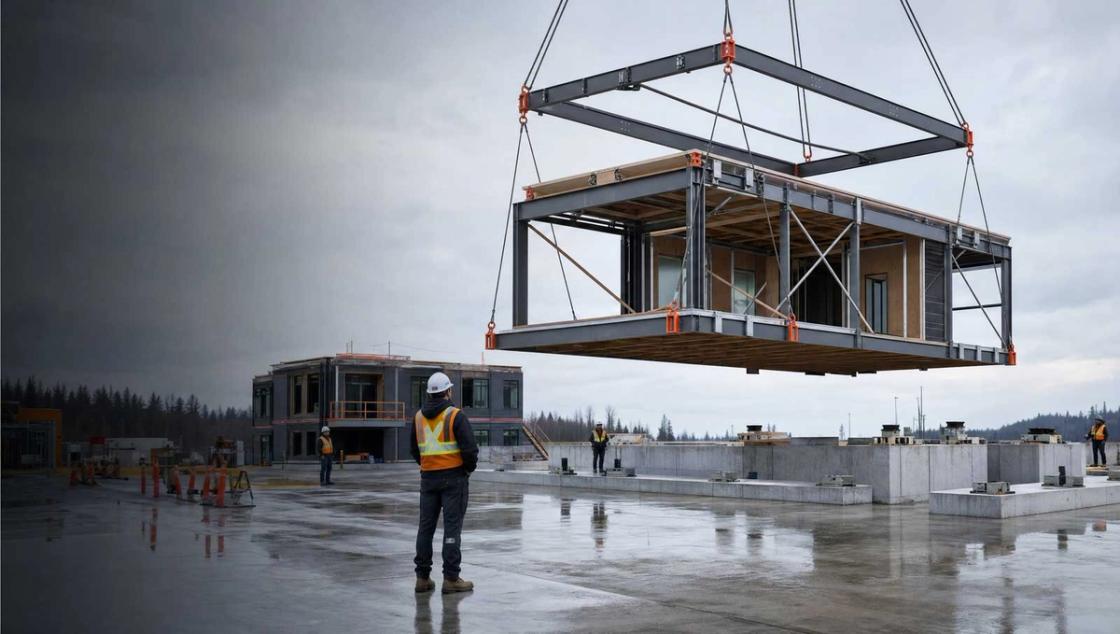



How the services connect
The services do not form one rigid sequence. Several can run together when inputs, owners and approval gates are clear.
- System selection sets the basis for design, engineering, production and logistics.
- DfMA converts that basis into grids, interfaces and design locks.
- Structural, MEP and energy work test different parts of the coordinated design.
- Digital delivery carries approved information, status, changes and evidence across stages.
- Factory and site changes return to the responsible party when they affect safety, performance or compliance.
Three ways to engage NAPS
-
One defined service
Use one service when the question, inputs, outputs and responsible parties are clear.
-
A coordinated service group
Use several services when one decision affects multiple disciplines or factory-site handoffs.
-
A service-scope review
Start with a review when the team does not know which service is needed or who should own each decision.
Review output: Recommended scope, information request, responsibility map, key interfaces and next decision gate.
The service-scope process
Review the project
Confirm the building, location, stage, design status, team, offsite assumptions and manufacturer status.
Identify open decisions
Separate system, design, structural, MEP, performance, data, logistics and approval questions.
Select the scope
Assign each question to the correct service, existing consultant or specialist partner.
Define handoffs
State the required inputs, outputs, reviewer, approval point, exclusions and schedule.
Deliver and control changes
Complete the assigned work and return cross-discipline changes to the responsible parties before release.
Who the service model supports
NAPS works with developers and owners, architects and engineers, contractors and construction managers, offsite manufacturers and suppliers, municipalities and housing providers, and institutional or public-sector teams.
Each group needs a different view of the same decisions. The scope should state who provides information, who reviews it, who approves it and who remains responsible for implementation.
Services across Canada and the United States
NAPS supports professional project teams across both countries. The scope must adapt to the authority, adopted codes, professional licences, factory-site inspection split, certification route, manufacturer, transport plan and public-client requirements.
NAPS performs only the work stated in its contract. Architects, engineers, manufacturers, contractors, trades, specialist partners and authorities keep their assigned duties. NAPS cannot guarantee a professional seal, permit, certification, inspection, financing or acceptance result.
Frequently asked questions
What services does NAPS provide?
NAPS offers six connected areas: modular and panelized planning, modular design and DfMA, structural engineering coordination, MEP coordination and prefabrication, energy and envelope performance, and digital delivery.
Does every offsite project need all six services?
No. The correct scope depends on the project stage, existing team, system, jurisdiction, manufacturer and unresolved decisions. A project may need one service or several connected services.
Where should a project start if the offsite system is not selected?
Start with Modular & Panelized Construction Services. It compares volumetric, panelized, hybrid and conventional approaches against the building, site, approvals, transport, schedule and supply-chain constraints.
Can NAPS join an existing project team?
Yes, when the contract defines the NAPS role, inputs, outputs, interfaces and approval responsibilities. The scope should fill a clear gap without duplicating or transferring another party's professional duties.
Does NAPS manufacture or install building components?
The answer depends on the project contract and delivery team. The public scope must state whether NAPS coordinates, procures, manages or directly performs any production, transport or installation work.
How are licensed engineering services handled?
Professional engineering work must be completed and sealed by professionals authorized for the project jurisdiction and assigned scope. NAPS must name the responsible entity or state that it coordinates with authorized professionals.
Build the right scope before building the system
Send the current project information and open decisions. NAPS will identify which services fit, how they connect and which responsibilities remain with the existing team or specialist partners.
Serving professional project teams across Canada and the United States, subject to scope, jurisdiction, authorization and partner availability.