

Building Energy Modeling & Envelope Performance
Test performance before repeated details move into production.
NAPS coordinates building energy modeling and envelope-performance analysis with specialist partners for modular, panelized and hybrid projects. The team compares heat transfer, airflow, solar gain, envelope interfaces and system choices before the design repeats in the factory or on site.
Send the design, location, code path and performance targets. We will define the model, inputs, decisions and specialist roles needed for a useful review.

What is building energy modeling?
Building energy modeling is a physics-based software simulation of building energy use. It combines geometry, envelope properties, lighting, equipment, HVAC systems, controls, schedules and local weather. The model estimates loads, energy use, comfort and related measures under stated assumptions.
Different analyses answer different questions:
Compliance modeling
follows an adopted code or program method.
Design-performance modeling
compares envelope, glazing, system or control options under common assumptions.
Load analysis
estimates heating and cooling loads; final equipment sizing remains with the responsible mechanical professional.
Thermal bridge or moisture analysis
studies selected assemblies and junctions using defined geometry, materials and boundary conditions.
Carbon analysis
records emissions linked to modeled operation or included material life-cycle stages.
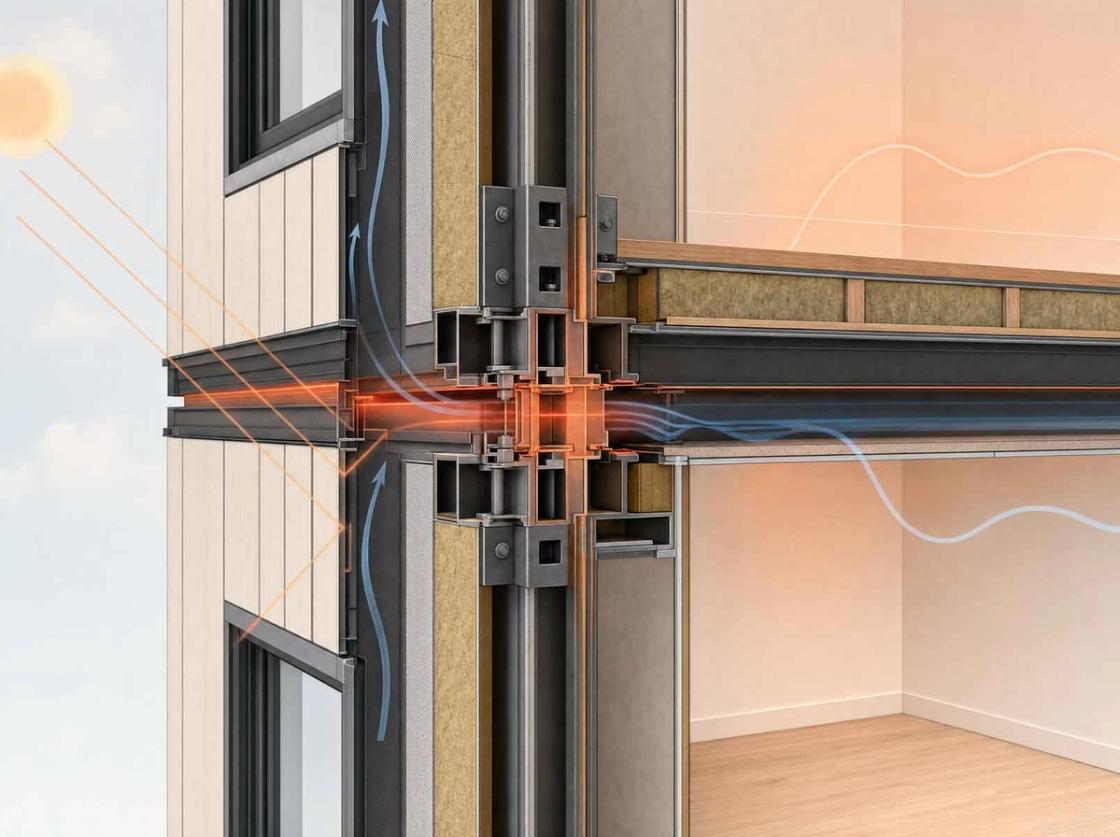
A model supports decisions. It does not predict an exact utility bill or prove installed performance. Weather, occupancy, controls, workmanship, commissioning, maintenance and later changes affect real results.
Why offsite envelope details need early analysis
Offsite production can improve control over repeated work. It can also repeat one unresolved detail across many modules or panels.
-
Module joint
Do insulation and air, water and vapour-control layers remain continuous?
-
Panel edge or corner
Do framing, fasteners or plates create a repeated thermal bridge?
-
Floor, roof or double-wall zone
Do added structure and cavities change heat flow, drainage or drying?
-
Balcony, canopy or exterior support
Can the structural penetration preserve thermal and air-water continuity?
-
Factory-to-site closure
Which layers are completed in the factory, and what needs field access and inspection?
-
MEP penetration
Do sleeves, curbs, seals, fire stopping and drainage preserve the performance target?
Transport exposure and accumulated tolerances can also change the modeled assembly. An energy model cannot correct a detail that cannot be built, inspected or repaired. The performance model and production detail must develop together.
Inputs, assumptions and honest results
A useful model needs an input register that identifies each source, revision, owner, status and confidence level.
Core inputs include:
- project location, weather, use, geometry, orientation and zoning;
- occupancy, lighting, equipment and operating schedules;
- envelope build-ups, glazing, shading, thermal bridges and airtightness;
- HVAC systems, ventilation, controls and hot-water assumptions;
- code path, owner target, software, method and quality-review status;
- energy, emission-factor or material data needed for cost or carbon work.
Label every result as an estimate, comparison, compliance output, measured value or calibrated finding. Keep common assumptions when comparing options. Show sensitivity where uncertainty could change the decision. Separate annual energy, peak demand, cost and carbon. Never promise savings without a baseline, method, model version and responsible reviewer.
Use the model while decisions can still change
At feasibility, the model can test climate, massing, orientation, window area and broad envelope or system options. During concept and schematic design, it can compare glazing, shading, assemblies, airtightness, thermal bridges and HVAC approaches under common assumptions.
During design development, the team can test selected products, controls, schedules and detailed interfaces. Before production release, the model inputs should match issued joints, penetrations, closures and approved substitutions. Construction or commissioning data becomes verification evidence only when the assigned scope, method and acceptance criteria are clear.
Starting early gives the team more useful choices. A late compliance model may identify a problem after geometry, products or repeated details are costly to change.
The NAPS modeling and envelope-performance process
-
Define the decision and scope
Confirm the project goals, offsite strategy, jurisdiction, code path, performance targets and included analyses.
output: Scope, responsibility matrix, target register and modeling plan.
-
Build the input register
Collect current geometry, assemblies, systems, schedules, products and criteria. Assign an owner and assumption to missing information.
output: Input register, information request and uncertainty list.
-
Create the baseline
The assigned specialist builds and checks the common reference model using the agreed weather, schedules, envelope and systems.
output: Baseline model, input summary and review record.
-
Test choices that can still change
Compare selected envelope, glazing, shading, airtightness, thermal-bridge, HVAC, control and renewable options under clear assumptions.
output: Scenario matrix, sensitivity findings and decision brief.
-
Connect findings to offsite details
Apply targets to module joints, panel edges, supports, penetrations and factory-to-site closures. Check whether revised details change model inputs.
output: Interface review and assigned thermal or moisture actions.
-
Confirm compliance and carbon paths
Record the adopted code, reporting method, study boundary, time period, responsible professional and required approvals.
output: Assigned compliance, performance or carbon reports.
-
Hand targets to production and verification
Check issued products and details against the model assumptions. Route substitutions, site changes and test results through controlled review.
output: Production handoff, exception log and verification plan.
Compliance, optimization and verification are different
-
Prescriptive compliance
checks listed components and systems against adopted requirements.
-
Performance compliance
follows an approved whole-building comparison method.
-
Design optimization
compares project options under common assumptions.
-
Program modeling
follows a named rating, incentive or performance method.
-
Calibrated modeling
compares simulation with measured operation.
Do not use “code compliant,” “Passive House,” “net zero,” “certified” or “verified” unless the exact pathway, version, responsible professional and project status are approved.
Canadian provinces, territories and some municipalities adopt or adapt national model codes. US states and local authorities adopt different energy-code editions and amendments. Confirm the current code, compliance path and authority for the project location. Publication of a model-code edition does not mean universal adoption.
sources
- US Department of Energy — About Building Energy Modeling
- National Research Council Canada — National Energy Code for Buildings 2025
- National Research Council Canada — Model-code development and adoption
- US Department of Energy — State energy-code portal
- National Research Council Canada — Whole-building life-cycle assessment guidelines
Operational and embodied carbon need separate records
-
Operational carbon
Operational carbon comes from energy used to operate the building. It depends on modeled energy, energy sources, emission factors and the study period.
-
Embodied carbon
Embodied carbon comes from materials and construction processes within the selected life-cycle boundary. It depends on quantities, service lives, transport, construction assumptions and environmental data.
Do not combine the two into one total unless the scope, time basis and methods are compatible and fully stated.
Typical deliverables
The signed scope selects the required outputs.
-
Modeling plan and input register
Defines decisions, method, software, roles, sources, assumptions and status
-
Baseline model and scenario matrix
Creates the common reference and compares selected options
-
Energy, load or compliance report
Records assigned results, methods, units and limits
-
Envelope and thermal analysis
Reviews selected assemblies, interfaces, thermal bridges or moisture risks
-
Operational or embodied-carbon report
States the relevant boundary, data, period and results when included
-
Decision, exception and verification register
Connects approved findings to production, changes and later evidence
Testing, commissioning, certification and life-cycle assessment are not included until the responsible specialist and signed scope are confirmed.
Frequently asked questions
What is building energy modeling?
It is a physics-based software simulation that combines building geometry, materials, envelope, systems, controls, schedules and weather to estimate loads, energy use, comfort and related measures under stated assumptions.
When should energy modeling start?
Start during feasibility or concept design while massing, glazing, envelope and system choices can still change. Update the model as products, details, schedules and controls become more certain.
What information is needed for a useful model?
The model needs location, weather, geometry, use, schedules, envelope properties, glazing, airtightness, systems, controls, loads and the code or performance target. Each input needs a source and status.
What is the difference between compliance modeling and design optimization?
Compliance modeling follows an adopted code or program method. Design optimization compares project options under common assumptions. One model can support both only when each method and result remains clearly separated.
How do module joints and panel interfaces affect performance?
They can interrupt insulation and air, water or vapour-control layers. Repeated framing, connections and closures can also create thermal bridges or moisture risks if the detail and installation sequence are not coordinated.
How accurate is an early-stage energy model?
Its value depends on the decision and input quality. Early models can compare options, but they contain more assumptions than later models. State uncertainty and update the model as the design becomes firm.
Test the decision before it becomes a repeated detail
Send the current design, envelope concepts, system basis, location and performance targets. NAPS will help define the model, partner scope, interface checks and decision handoff needed before production.
Serving professional project teams across Canada and the United States, subject to scope, jurisdiction, authorization and specialist availability.