

MEP Coordination & Prefabrication
Coordinate the systems before they reach the factory—or the site.
NAPS coordinates mechanical, electrical, plumbing and related fire-protection interfaces for modular and panelized projects. We help teams resolve space, access, penetrations, supports, factory-to-site connections, testing and installation sequence before assigned assemblies move into production.
Send the current architectural, structural and MEP information. We will identify coordination decisions and suitable prefabrication opportunities.

What is MEP coordination?
MEP coordination aligns mechanical, electrical and plumbing systems with each other and with architecture, structure, fire protection, equipment, access and construction sequence. It resolves the routes, openings, supports, clearances and interfaces needed to install, connect, test, operate and maintain those systems.
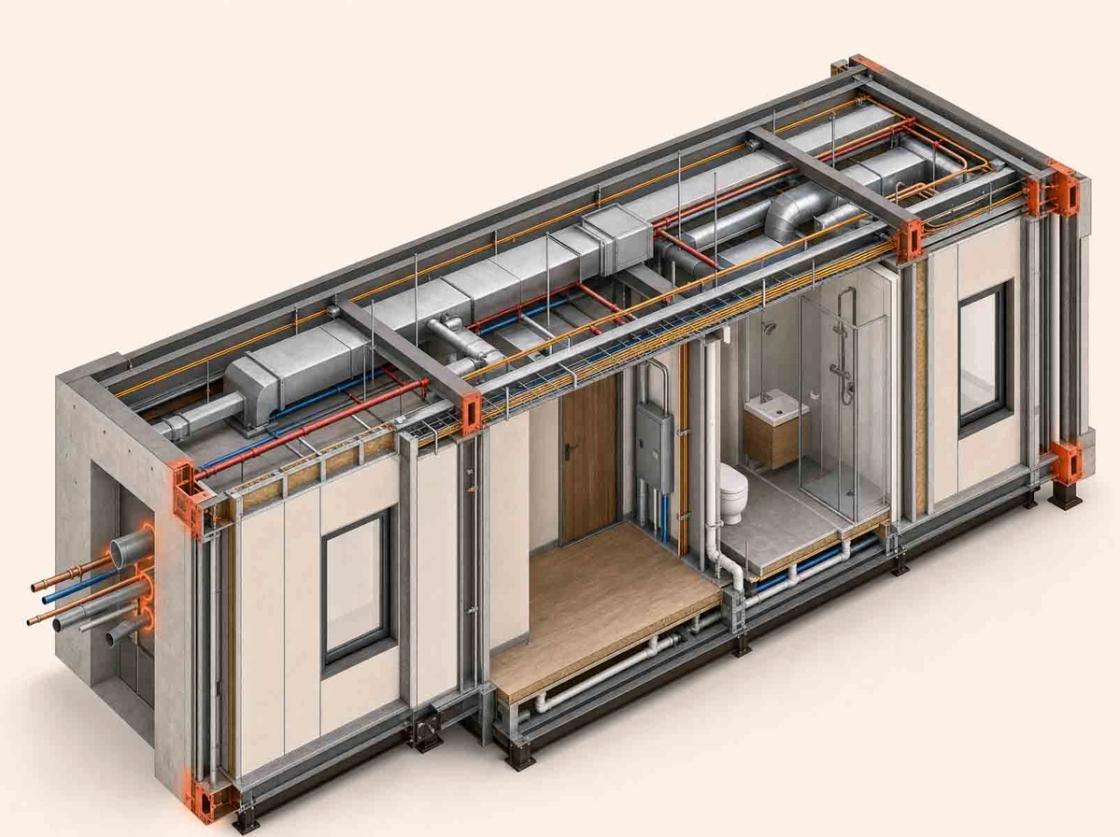
Coordination is not the same as engineering design. Engineering defines system criteria, capacity, calculations, performance and code basis. Coordination applies that approved information across disciplines. Fabrication detailing then converts approved design and coordination into trade- or manufacturer-specific production information.
Clash detection supports coordination, but it covers only selected model conflicts. Factory assembly, field testing and commissioning remain separate assigned responsibilities.
NAPS states its exact role on each project. Coordination does not transfer the engineer-of-record, trade, manufacturer or commissioning duties.
Clash-free is not the same as coordinated
A model can contain no hard clashes and still be impossible to install or maintain. A complete review should test:
-
Geometry
Do systems occupy the same space?
-
Clearance
Can panels open and equipment be removed?
-
Structure
Are openings, sleeves, supports and added loads coordinated?
-
Installation
Can the assembly move into position and can workers reach each connection?
-
Sequence and tolerance
Will closures or variation block later work?
-
Performance
Do route changes preserve slope, drainage, pressure, airflow and approved criteria?
-
Maintenance
Can valves, dampers, cleanouts, filters, controls and test points be reached?
The responsible engineer or trade must approve changes that affect performance or code compliance. A coordinator must not solve a clash by moving a system outside its approved design basis.
MEP prefabrication options
Prefabricated MEP systems combine components into an offsite assembly for later installation. The useful unit can contain one trade, several trades or a complete room system.
-
Horizontal multi-trade racks
Often fits: Repeated, dense corridor or ceiling zones
Resolve early:
- Size, weight, supports, branch connections, access and insertion route
-
Vertical riser modules
Often fits: Repeated floor-to-floor service risers
Resolve early:
- Geometry, expansion, supports, accumulated tolerances and joint access
-
Plant skids
Often fits: Repeated equipment arrangements
Resolve early:
- Equipment, structural base, controls, testing, isolation and replacement path
-
Bathroom pods or utility walls
Often fits: Stable repeated wet-room layouts
Resolve early:
- Connections, waterproofing, fire, acoustics, fixture access and testing
-
In-module distribution
Often fits: Volumetric modules with stable service zones
Resolve early:
- Module interfaces, transport protection, concealed tests and site hookups
-
Single-trade assemblies
Often fits: Repeated pipe, duct, conduit or cable-tray runs
Resolve early:
- Break points, joints, supports, labels and installation sequence
NAPS does not claim to manufacture these products. A conventional installation can be the better choice when layouts, equipment or site conditions remain unstable.
When prefabrication is a strong fit
MEP prefabrication is more likely to work when layouts repeat, products and connection points can be approved early, service density justifies the assembly, and trades and manufacturers can coordinate before release. Transport and site routes must support the assembly. Inspection, testing, maintenance and replacement access must remain clear.
The team must also confirm who supplies supports and controls, where factory work ends, how site connections are tested, and which evidence must exist before an assembly is concealed or shipped.
The goal is not to maximize factory work. It is to select assemblies that improve the complete design, production, delivery and commissioning path.
The NAPS MEP coordination process
-
Confirm criteria and responsibilities
Review current design information, equipment, offsite strategy, manufacturer status, schedule and approval path. Name the engineer, trade, coordinator, manufacturer, contractor and commissioning roles.
output: Information request, responsibility matrix and coordination plan.
-
Set zones and targets
Map plant, riser, corridor, unit, module and site-built areas. Test racks, risers, pods, skids, in-module systems and conventional work.
output: Prefabrication assessment and zone map.
-
Combine and check information
Use agreed files, coordinates, status and update dates. Check geometry, clearances, openings, supports, access, sequence, tolerance and maintenance.
output: Federated model where included, issue register and clash reports.
-
Resolve issues with responsible parties
Assign each issue an owner, due date and approval route. Return performance and code changes to the responsible engineer or trade.
output: Approved decisions and updated coordinated information.
-
Review fabrication readiness
Check approved design, dimensions, products, supports, connections, tolerances, sequence and test requirements before release.
output: Readiness checklist, open-item list and release status.
-
Coordinate factory quality and logistics
Define concealed-work checks, tests, labels, protection, lifting, delivery order and receiving conditions.
output: Inspection and test matrix plus installation handoff.
-
Connect factory work to commissioning
Link factory records with receiving, interconnection tests, field changes, deficiencies, commissioning and handover information.
output: Test, deficiency and record-information handoff within scope.
From factory test to commissioned system
Reliable handoffs need current approved design information, coordinated fabrication inputs, defined inspection points, transport protection, site receiving checks, accessible connections and clear test boundaries.
Factory testing does not automatically replace site testing or commissioning. The adopted code, authority, design team, manufacturers and commissioning plan decide what must be inspected or tested before concealment, after transport and after site connection.
Maintenance is also a design input. Before fabrication, preserve working space, access panels, removal routes and safe access to valves, dampers, filters, cleanouts, controls and test points.
Typical deliverables
The signed scope selects the required outputs.
-
Coordination plan and responsibility matrix
Defines inputs, roles, checks, approvals and release rules
-
Prefabrication assessment and zone map
Identifies suitable assemblies and their project locations
-
Federated coordination model and issue register
Records current geometry, clashes, clearances and issue decisions where included
-
Opening, support and assembly coordination
Aligns penetrations, loads, access and factory-site interfaces
-
Fabrication-readiness review
Identifies missing or unapproved information before release
-
Inspection, test and commissioning handoff
Transfers factory, receiving, connection, deficiency and record status
Engineering calculations, sealed designs, trade shop drawings, fabrication models, factory tests and commissioning reports are not NAPS deliverables until the responsible entity and scope are confirmed.
Codes, licences and offsite requirements
Offsite fabrication changes where work occurs and when concealed items are checked. It does not reduce code, product, inspection or professional duties.
Canada
The project must follow adopted codes, product requirements, trade rules and authority processes. Engineering is regulated by provinces and territories. CSA Z250:21 describes modular delivery processes. CSA A277-16 (R2025) addresses factory certification. Neither replaces MEP design, site connections, inspections or approval.
United States
ICC/MBI 1210-2023 addresses offsite MEP elements from design through assembly. Adopted mechanical, electrical, plumbing, fuel-gas, fire and energy rules still vary by state and local authority. Professional engineering rules also vary by jurisdiction.
Important: Confirm the engineer, trade, manufacturer, certification body, inspector, commissioning provider and authority responsibilities before fabrication.
Frequently asked questions
What does MEP coordination mean?
It aligns mechanical, electrical and plumbing systems with architecture, structure, fire protection, access and sequence. It resolves routes, spaces, openings, supports, clearances and interfaces before installation or fabrication.
How is MEP coordination different from MEP design?
MEP design defines system criteria, calculations, capacity, performance and code basis. Coordination aligns the approved systems with the building and other trades. Changes affecting performance or code return to the responsible engineer.
Which MEP systems can be prefabricated?
Options include multi-trade racks, riser modules, plant skids, bathroom pods, utility walls, in-module distribution and single-trade assemblies. Fit depends on repetition, design stability, access, logistics, testing and economics.
Is BIM clash detection enough for MEP coordination?
No. Clash detection finds selected model conflicts. Coordination must also check working clearances, access, code conditions, supports, tolerances, installation sequence, testing, replacement paths and approved design criteria.
How is maintenance access protected in a prefabricated assembly?
Reserve working space, access panels, equipment-removal paths and safe access to valves, dampers, filters, cleanouts, controls and test points before fabrication. The responsible parties must approve the arrangement.
Does factory testing replace site testing and commissioning?
Not automatically. Factory tests can verify work before concealment or shipment. Site teams still need receiving checks, interconnection tests and any verification required by the code, authority, design documents, manufacturers and commissioning plan.
Coordinate the systems before fabrication locks them
Send the current design information and offsite strategy. NAPS will help define the coordination scope, prefabrication options, issue process and factory-to-site handoffs.
Serving professional project teams across Canada and the United States, subject to scope, jurisdiction, authorization and partner availability.